We like to believe that culture influences the things we buy. But sometimes, it’s the other way around.
Some of the customs and traditions we believe to be timeless were created in a meeting room by some marketing guys – with a sales quota attached to it.
These aren’t myths. They’re real, working marketing campaigns that have become part of how we live.
Here are three of them.
Diamonds Were Never About Love
They were about inventory.
For most of history, diamonds belonged to kings and queens. They were so rare that owning one meant power.
For example – in the 1900’s, one Indian King from Hyderabad gifted Queen Elizabeth an awe-inspiring platinum Cartier necklace featuring roughly 300 diamonds, as a wedding gift.
Its value today is 80 million pounds.
In another instance, the mind -boggling 3106-carat, largest rough diamond ever found – was gifted to King Edward VII of the United Kingdom – by the Transvaal Government.
This is worth 2 Billion Dollars today.
When huge diamond deposits were later discovered in South Africa – the “rarest” stone on earth wasn’t rare at all.

That was a problem. If diamonds are everywhere, they’re worth nothing.
So a cartel was formed to fix this problem. This cartel is the now famous De Beers.
The first thing they had to do was to now sell it to the commoners without letting go of the premium pricing.
De Beers first controlled the supply to create artificial scarcity to keep prices high. And the next thing they did was to convince the ordinary people that it was precious.
But precious for what?
The smart move was – they tied this diamond to one thing that no one dares to cheap out on – LOVE.
In 1947,they hired a copywriter named Frances Gerety, who wrote the famous line – “ Diamonds are Forever”(Officially named the slogan of the century) for an ad campaign.
By linking the physical durability of a diamond to the abstract concept of eternal love, they were able to create a magical feeling to this purchase.
Then they priced this feeling.
There was no looking back. In 1951, the adoption rate of diamonds among American brides skyrocketed to 80%. The campaign peaked during the fag end of the 20th century – where – proposing without a diamond ring was culturally unthinkable to the mainstream consumer.
Can you believe that Ben Affleck wooed his ex, Jennifer Lopez again – by gifting her a natural green diamond worth $6 million.
So, that’s how it is done.
The Most Important Meal
For most of the 1800s, the American breakfast was heavy – meat, fried food, eggs, whatever filled them up before a hard day’s work.
Then there was Dr. John Harvey Kellogg, who ran a hospital in Battle Creek, Michigan.
He was, to put it gently, a man of intense beliefs. He thought – all that rich, heavy food was bad for people. He was always on the quest to invent plain, simple meals for his patients instead.
One of those experiments became corn flakes.
The story goes that – when he and his brother Will, boiled some grains and pushed it through a roller, it broke into flakes. When they toasted it, a new product was born.
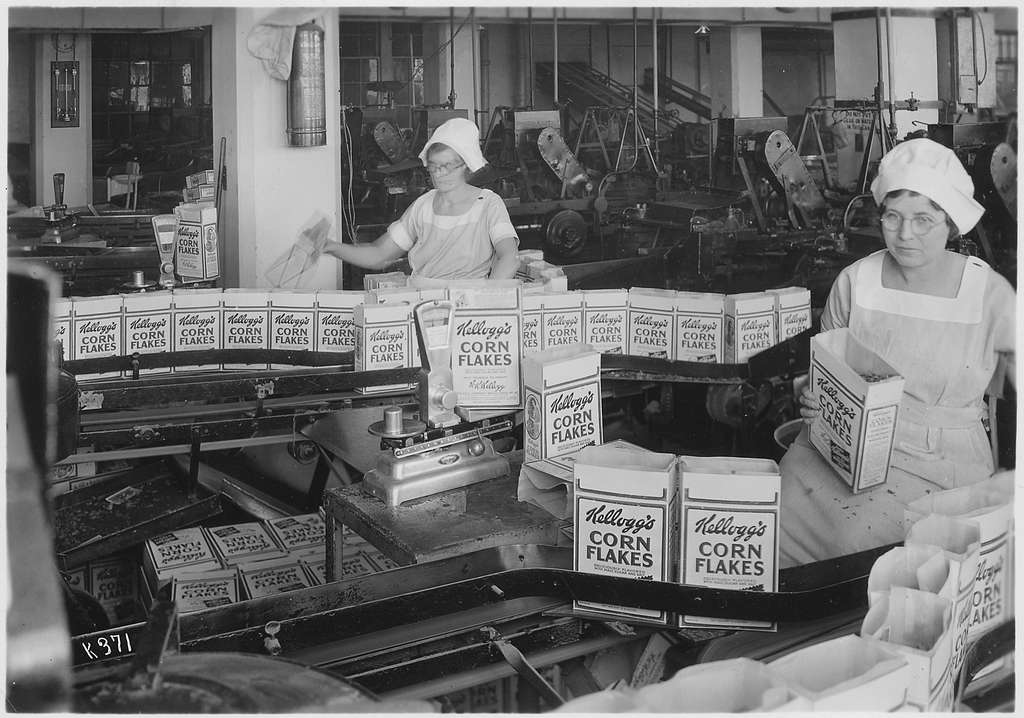
For a while it stayed exactly that. A plain hospital food. It was not something that normal people ate.
Then the doctor’s brother, Will Keith Kellogg, spotted an opportunity.
He added sugar to make it tasty, put it in a box and branded it. This is how the now famous Kellogg’s brand was created.
He pitched the Cereal as a light, clean modern food. And by pushing the idea that “ Breakfast is the most important meal of the day”, he made sure that people replace their old breakfast with his new product.
Call that genius.
The true origin of that phrase might be a little murky, but what’s absolutely true is that the idea of “Cereals as breakfast” was a result of one hospital’s experiment and some clever marketing.
Santa And His Reindeers
If you’ve ever seen a picture of Santa Claus, you’ve probably seen the full setup: a man in a red suit, a sleigh full of gifts, and a team of reindeers pulling it through the sky and descending down the chimneys.
In this modern version – there are nine reindeers. And the one leading the pack – is the red nosed Rudolph.
Eight of the reindeers(except Rudolph) – come from a famous poem(A Visit from St. Nicholas) written back in 1823. And for the next hundred years – those 8 were the full team.
So where did the ninth one come from?

The answer lies in an American retail chain called Montgomery Ward.
Montgomery Ward had a history of purchasing coloring books and distributing them free to families visiting their stores during Christmas. But in 1939, the management decided to bring down corporate costs due to the effects of the Great Depression.
The management decided that it would be cheaper to publish their own coloring booklet. This task was given to one of their copywriters named Robert.L.May.
He was tasked with writing an original story featuring an animal. He came up with a misfit reindeer with a glowing red nose and that was how the most famous, ninth reindeer Rudolph was born.
It was, at its heart, an advertisement. A free giveaway designed to pull people into the store.
The 32-page booklet acted as a massive “sales gimmick,” successfully drawing millions of parents and their wallets directly into Montgomery Ward toy departments.
By 1946, despite wartime paper shortages, the store had distributed over 6 million copies.
The popularity was such that – the poem was adapted into a song which went on to become the second best selling Christmas song of all time.
The commercial explosion of Rudolph transformed him into a multi-million dollar global franchise. By the time of May’s death in 1976, Rudolph was licensed into more than hundred different products.
Today, many historians consider Rudolph the first Christmas myth created purely via corporate advertising that successfully integrated into the global folklore.
None of these copywriters sat down to invent a tradition. They were writing ads, hitting deadlines and trying to sell their products. The “culture” part happened later, once the campaigns caught on. And clever marketing kept the momentum going.
Which makes me wonder – was it really just sharp marketing? Or something else was at play, which made people accept it as a part of the culture?
Curious about what the marketers here think. Drop your take in the comments.
Pingback: terbinafine mechanism for ringworm
Pingback: ketorolac tromethamine safety
Pingback: terbinafine nail infection treatment
Pingback: toradol onset explained
Pingback: ivermectin educational overview
Pingback: ivermectin scabies data
Pingback: minoxidil evidence summary
Pingback: minoxidil men’s vertex regrowth
Pingback: minoxidil pharmacokinetics
Pingback: sildenafil molecular action
Pingback: vardenafil full strength
Pingback: avanafil food‑related effects
Pingback: vardenafil contraindications
Pingback: avanafil online safety context
Pingback: vardenafil citrus interaction
Pingback: avanafil cost determinants
Pingback: vardenafil PK overview
Pingback: vardenafil warning conditions
Pingback: orlistat mild side effects
Pingback: pneumonia antibiotic overview
Pingback: sinusitis inflammation guide
Pingback: Official Resource
Pingback: Duration Variability Mechanisms
Pingback: Sildenafil PD Reference
Pingback: SildenafilVsTadalafil
Pingback: sildenafil uses, brands and forms
Pingback: tadalafil brand guide