A Roadmap to Omni-Channel Experience
Audit and Strategy for Borrelli Crafters
The Problem
Borrelli Crafters had the craftsmanship. What it lacked was credibility at first glance.
A basic website with no credentials visible, an inactive LinkedIn, and no digital presence to speak of meant high-value prospects were forming their opinion — and walking away — before a single conversation began.
In a market where trust is everything, the front door was letting the business down.
Our Approach
Before building an omnichannel strategy, the priority was fixing what prospects saw first -recommending a professional website overhaul and a LinkedIn presence built around thought leadership and Red Seal credentials.
From there, the strategy mapped the complete buyer journey across 10 stages, from first awareness all the way through to win-back — ensuring that even prospects who showed interest but didn’t convert were re-engaged through structured, automated outreach.
At each stage, specific MarTech tools were recommended to show exactly where and how technology could close the gap between what Borrelli was delivering and what a high-value client expected.
Table of Contents
The Client
Borrelli Crafters is a custom home building company based in Marmora, Ontario. Led by Matt Borrelli — a Red Seal Certified craftsman — the company builds bespoke cottages and luxury homes using sustainable materials and proven construction techniques. Every project is delivered to the highest trade standards, backed by over 10,000 hours of certified training.
What sets Borrelli apart from most local builders is simple — credentials. In a market dominated by multigenerational family businesses and self-taught contractors, Red Seal certification is a meaningful differentiator. It signals structural quality, code compliance, and professional accountability that most competitors simply cannot offer.
Despite the quality of the work, the business had one significant gap — its digital presence did not reflect its standards. And in a market where high-net-worth clients research extensively before making contact, that gap was costing the business its most valuable prospects.
Client Requirements
The brief came from a real client — Borrelli Crafters approached George Brown College as part of the MARK4024 Omnichannel Marketing course. The task was not just academic. It was a working brief with a real business goal attached to it.
The SMART Goal Establish Borrelli Crafters as the top choice for custom builds and renovations in Marmora and the surrounding area — reaching $2.5M in annual revenue by 2027.
The Core Challenge Audit Borrelli’s existing path to purchase across all channels, identify where high-value prospects were dropping off, and recommend a strategy to close those gaps.
Target Markets Two clearly defined segments from the PRIZM segmentation model:
- Wealthy and Wise — Affluent homeowners aged 45–70, building legacy properties and prioritising quality over cost
- Big Fish, Small Pond — Mid-career professionals aged 35–55, relocating from urban centres to rural Ontario while maintaining high incomes
Current State at the Time of the Brief
- No marketing technology in place
- Website and social media underperforming
- All client touchpoints owned and managed manually by Matt Borrelli alone
Our Approach
When we first looked at Borrelli Crafters as a business, the problem was immediately visible on a screen. The website felt generic. The LinkedIn page was inactive. And the overall digital presence communicated nothing about the quality of the actual work being done on the ground.
Before mapping a strategy, we needed to understand what a real Borrelli prospect actually experienced. Not in theory — in practice. What did they see when they searched? What did they feel when they landed on the website? Where did the trust break down?
That question drove everything that followed.
Step 1 — The Storyboard
We started by building a storyboard — a visual narrative of how a high-value prospect like Marcus Thorne, a VP of Marketing earning $250K–$300K, would discover and evaluate Borrelli Crafters in the real world.
The storyboard mapped 12 frames across four phases — Far Store, Near Store, In Store, and After Store — showing every physical and digital touchpoint Marcus would encounter, from seeing a Borrelli branded vehicle on the road to interacting with Matt at a consultation table.
This wasn’t just a creative exercise. It forced us to think like the customer before recommending anything. And what it revealed was consistent — at almost every touchpoint, the experience fell short of what a high-net-worth buyer expected.
Step 2 — The Infographics
With the customer story mapped, we built two infographics to define exactly who Borrelli should be targeting and how to segment them effectively.
The first was a detailed customer persona — Marcus Thorne — bringing the target buyer to life through demographics, psychographics, and behavioural patterns. Marcus wasn’t just a profile. He was a decision-making framework. Every channel recommendation that followed was tested against one question — would this work for Marcus?
The second was a customer segmentation model using a Predictive CLV approach, identifying three distinct client types — The Heritage Ambassador, The Legacy Loyalist, and The Prospecting Visionary — and recommending specific action strategies for each.
Step 3 — Current State Buyer Journey
This was the most detailed piece of work in the project. We mapped Marcus’s complete buyer journey across 10 stages — Awareness, Interest, Engagement, Consideration, Conversion, Onboarding, Loyalty, Development, Advocacy, and Win-Back.
At each stage we documented four things — what Marcus was feeling, what touchpoints he was using, what he expected from Borrelli, and where the current experience failed him. The gaps were significant at every stage. No CRM. No lead capture. No client portal. No referral program. Communication entirely dependent on Matt’s availability.
The current state journey wasn’t just an audit — it was a diagnosis. And the diagnosis was clear: this was not a workload problem. It was a systems problem.
Step 4 — The Final Presentation
The presentation brought everything together into a cohesive recommendation for the client. Rather than presenting a generic digital marketing plan, we structured the entire strategy around closing the specific gaps Marcus experienced at each stage of his journey.
Key recommendations included an SEO and paid Meta ads strategy at awareness, a lead magnet and on-demand webinar at engagement, a digital proposal and DocuSign workflow at conversion, CoConstruct for real-time project visibility during the build, and HubSpot’s agentic AI managing lead scoring, nurture sequences, and win-back automation throughout.
At each stage we recommended specific MarTech tools — not as a technology wish list, but to show exactly where and how each tool would improve Marcus’s experience and move Borrelli closer to its $2.5M revenue goal.
One deliberate strategic decision shaped the entire recommendation — we focused the digital strategy on the website and LinkedIn rather than Instagram and Facebook. The reasoning was straightforward. High-net-worth buyers in the 35–70 age range research custom builders through Google Search and LinkedIn. A polished Instagram feed would not move the needle for this audience. Fixing the front door would.
The Visuals
DELIVERABLE 01 · STORYBOARD
The Phygital Touchpoint Story — 12 Frames
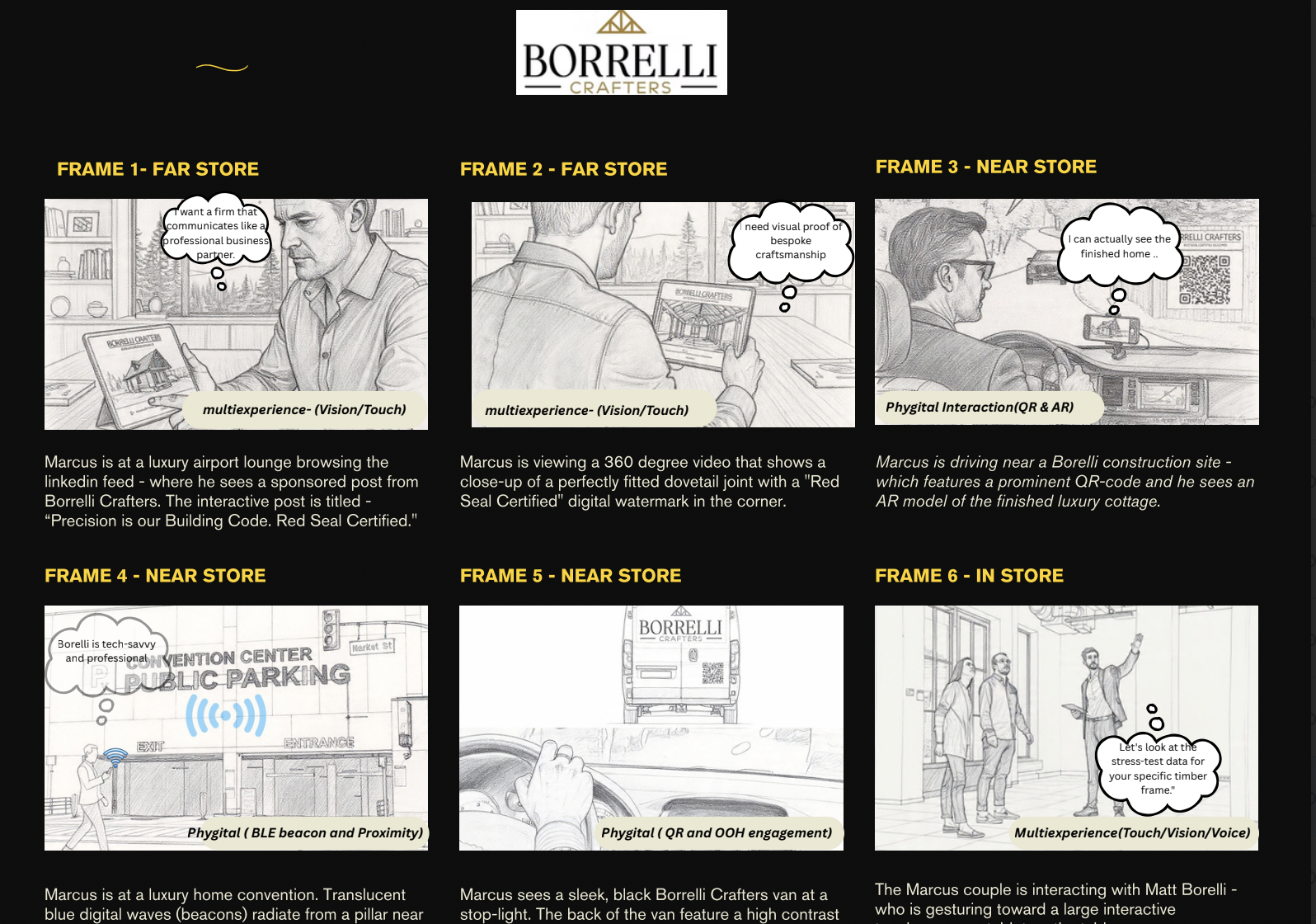
Built before any strategy was written — to understand what Marcus(customer persona) actually experienced at every touchpoint.
DELIVERABLE 02 · CUSTOMER INFOGRAPHICS
Marcus Thorne · Customer Persona & CLV Segmentation
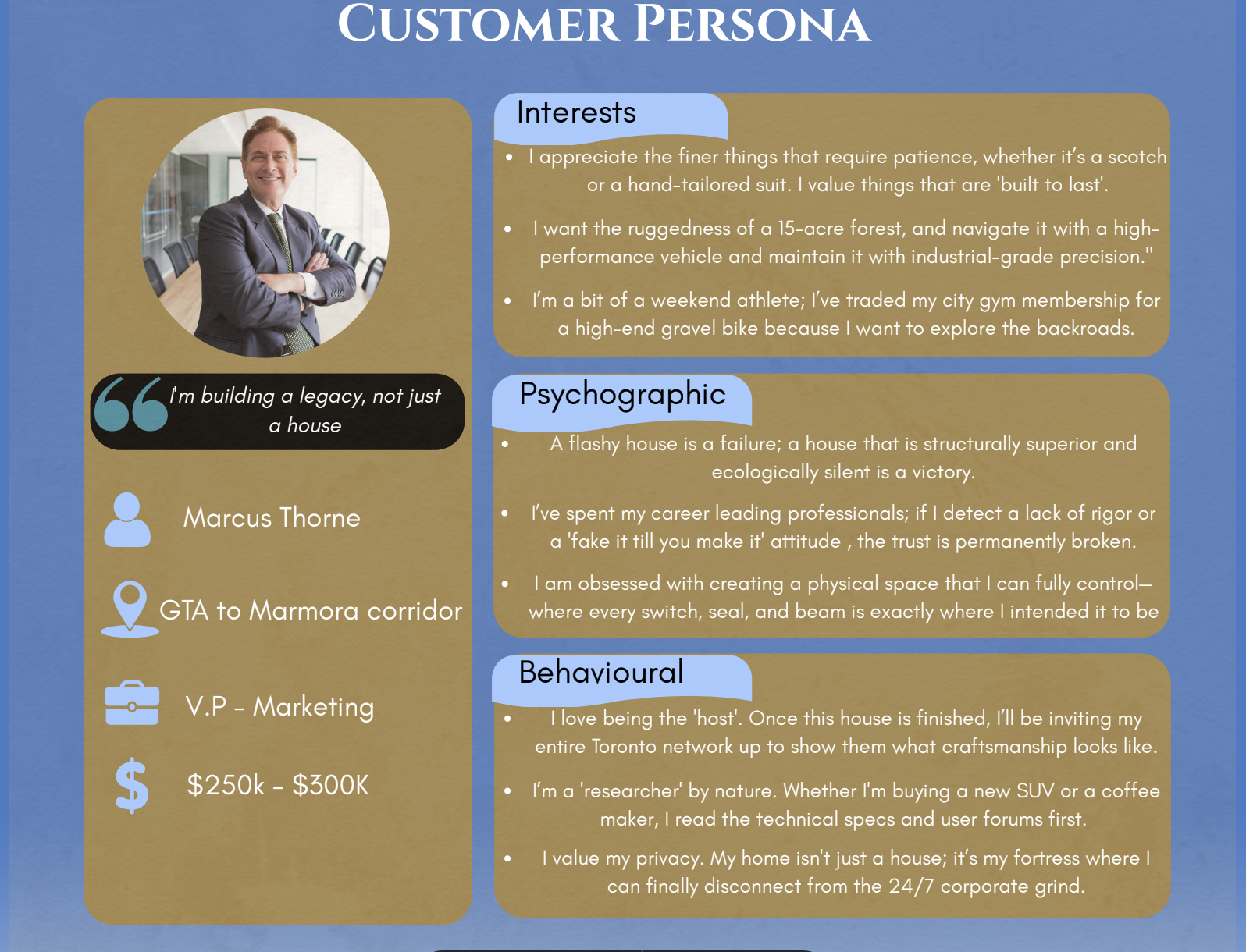
A snapshot of the broader infographic that defines the ideal customer along the lines of Interests, Behaviour and Psychographics.
DELIVERABLE 03 · CURRENT STATE BUYER JOURNEY
10-Stage Buyer Journey — Current State Gaps
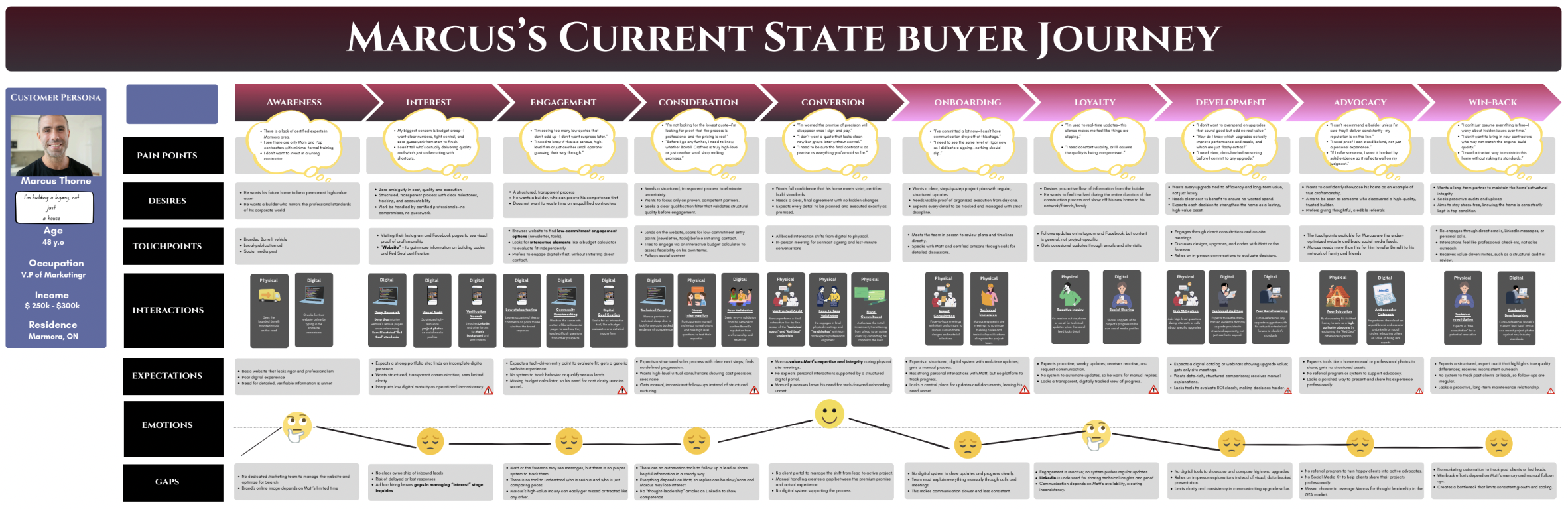
Every stage mapped against what Marcus expected versus what Borrelli delivered.
DELIVERABLE 04 · FINAL PRESENTATION
Strategy Presentation — Key Slide
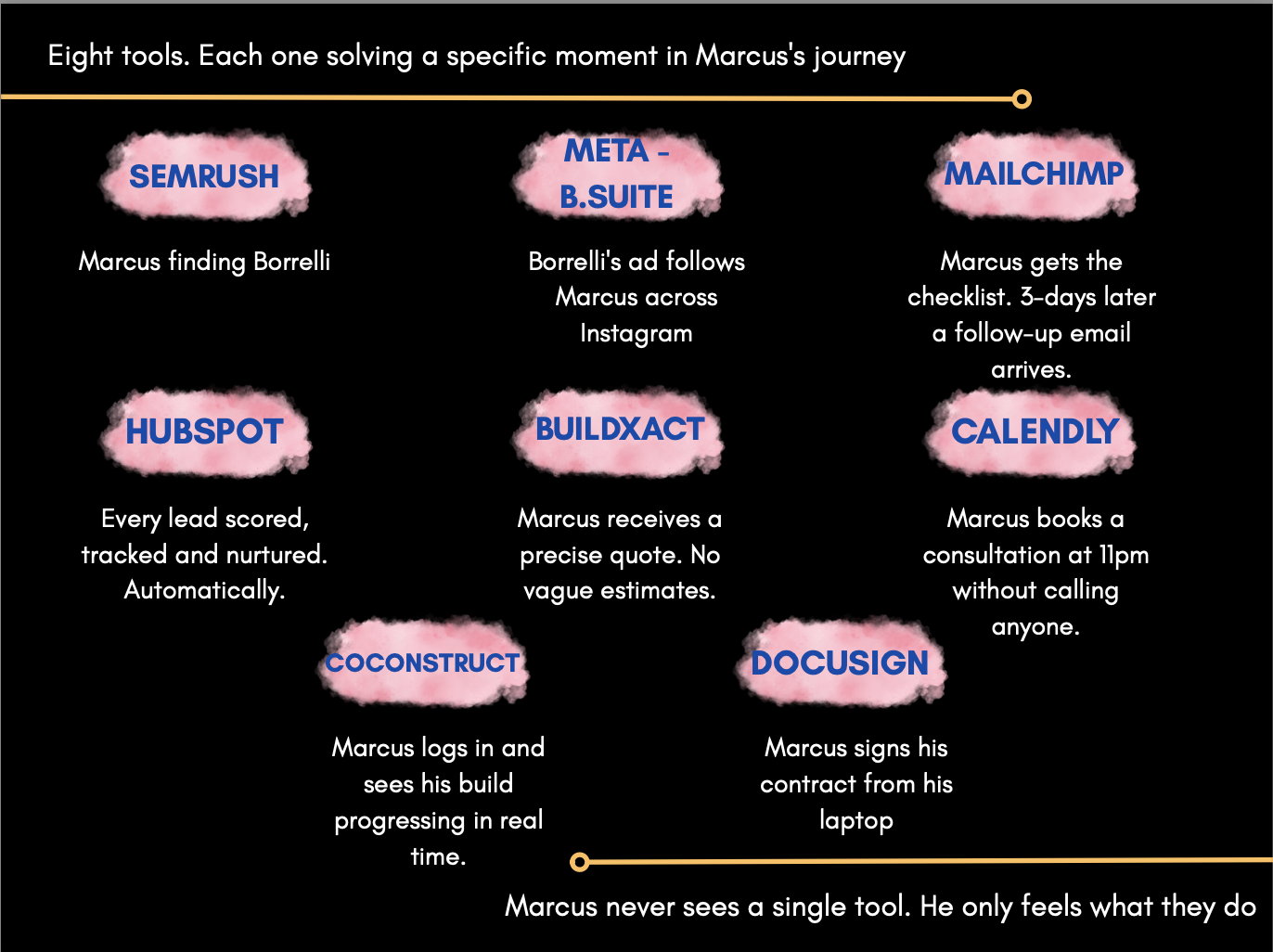
A screenshot of Martech stack recommendations structured around closing the gaps Marcus experienced at each journey stage.
My Learnings
1. Build the persona before the strategy
Before recommending a single channel or tool, we built Marcus Thorne — a detailed customer persona grounded in demographics, psychographics, and real buying behaviour. That decision shaped everything that followed. When you know exactly who you are trying to reach, every strategic choice becomes easier to justify and harder to get wrong. Without Marcus, the strategy would have been generic. With him, it was specific.
2. Journey mapping reveals what data alone never will
Mapping Marcus’s current state journey — stage by stage, emotion by emotion — exposed gaps that no analytics dashboard would have caught. The frustration at the engagement stage. The anxiety after signing. The feeling of being neglected during the build. Understanding how a customer feels at each specific moment is what separates a strategy that looks good on paper from one that actually works in the real world.
3. MarTech is no longer optional
Borrelli Crafters had zero marketing technology in place — and it showed at every stage of the journey. This project made one thing clear: for any business looking to grow today, MarTech is not a luxury. The right tools create awareness, capture leads, nurture prospects through the funnel, and keep clients engaged long after the sale. Without them, even the best strategy depends entirely on one person’s memory and availability.
4. Not missing on first impressions
A digital strategy is only as strong as the first impression it builds on. Before recommending channels, tools, or campaigns — understand what your prospect sees, feels, and decides in the first thirty seconds. Fix that first. Everything else follows.