Repositioning a Dine-in Restaurant as a Mobile Caterer
A 90-Day Paid Media Plan
Snapshot
90
Campaign Duration in days
$3600
Total Campaign Budget
180
Target Inquiries
50
Target Bookings
~ 30%
Inquiry to Booking Ratio
A 90-day paid media plan to reposition Alijandro’s Kitchen — a Mississauga food business pivoting from dine-in restaurant to mobile catering — and generate qualified inquiries within a 20km radius.
Meta Platform
Generate Demand
Google Search
Capture Intent
Win Corporate Trust
The Campaign Idea
“You Host. We Handle the Rest.”
Table of Contents
- XYZ
- XYZ
- XYZ
- XYZ
The Client
Alijandro’s Kitchen is a Mississauga based food business known for Mediterranean-Mexican fusion food. For years it ran two operations in parallel, a dine-in restaurant and a mobile catering service. In late 2025, the owner closed the dine-in side. The business would focus exclusively on catering – corporate lunches, private parties, and community events across the Mississauga area.
The food and the team didn’t change. But the business model now needed a marketing strategy that matched its exclusive offering of mobile catering.
The Business Situation
When a business changes what it sells, customer perception doesn’t catch up automatically. Alijandro’s Kitchen was no longer a dine-in restaurant, but search results, social profiles, and word-of-mouth still pointed to a place to eat, not a service to hire.
Closing that perception gap is what the campaign had to do.
Three constraints shaped the approach.
Strong product, weak visibility. A 4.3-star average rating on Google meant the food and the service already worked. Customers who tried Alijandro’s came back for the experience. Now, the job was to get in front of the right customers at the right moment.
Catering is intent-driven, not browse-driven. Nobody searches “Mississauga food caterers” out of curiosity. They search it when they have a Friday lunch event to organize. The campaign had to win at these specific high-intent moments along with building awareness.
Crowded market, undifferentiated competition. Multiple vendors fight for the same local searches. None of them lead with anything emotionally distinct. The campaign needed a positioning angle instead of service messaging.
How they’re seen now
A place to eat
How they need to be seen
A service to hire
Strategic Insight
INITIAL DIRECTION: OPERATIONAL
” We Bring The Restaurant To You”
Describes the Business
REVISED DIRECTION:EMOTIONAL
“You Host. We Handle The Rest”
Promises Emotional Benefit
The original creative direction ” We Bring the Restaurant to You” was operational in nature. Which means it describes the change in business direction – from dine-in to mobile catering. Eventhough it was accurate, it was forgettable.
Research shows that operational positioning of a brand loses to emotional positioning every time, because the customer isn’t buying the operation, they are buying an expected outcome of the product or service.
The question then became: what is the customer actually buying when they hire a caterer?
The food alone is table stakes. What they’re actually buying is the feeling of not having to worry about food on the day of their event.
A host doesn’t lie awake the night before worrying whether the Souvlaki skewers or Tacquitos will be good. They lie awake worrying whether the food will arrive on time and whether the buffet will be set up before guests show up, because if anything goes wrong then it reflects on them as the host.
The fear isn’t bad food. The fear is “what if something goes wrong?”
That fear is what every catering vendor competes on — whether they realize it or not.
The new campaign line does three things the old one couldn’t:
- It puts the host first: The Hosts are the hero of the event. Alijandro’s Kitchen is the operator who makes the hero look good.
- It promises the emotional outcome: “The Rest” is intentionally vague. Each customer fills in their own version of the anxiety they want to disappear.
- It works across audiences: The same line lands on a Meta birthday creative aimed at a private organizer, and on a LinkedIn corporate ad aimed at an HR manager. One emotional truth resonating with two audiences.
Buyer Personas

Priya Sharma / 32 / Homemaker
Mississauga · Birthdays, weddings, family gatherings
The Goal
Be a present, relaxed host at her daughter’s birthday — be present for the cake cutting, the photos and in all the moments she planned for weeks.
The Tension
Doing the food herself means spending the whole week planning and executing the lunch for guests, instead of celebrating her daughter.
What She Values
Reliability, Clear communication, Full-service execution
“I’m not hiring a caterer. I’m hiring the chance to actually be at my daughter’s party.”

David Chen / 38 / Event Planner
Toronto · Corporate lunches, team events, client meetings
The Goal
Run a corporate event that goes off cleanly — without it taking over his week.
The Tension
Most caterers need chasing – emails, confirmations, day-of check-ins, on top of his real job.
What He Values
Punctuality, Transparent pricing, Vendor independence
“I’m not hiring a caterer. I’m hiring a vendor I don’t have to manage on top of my real job.”
The Channel Architecture
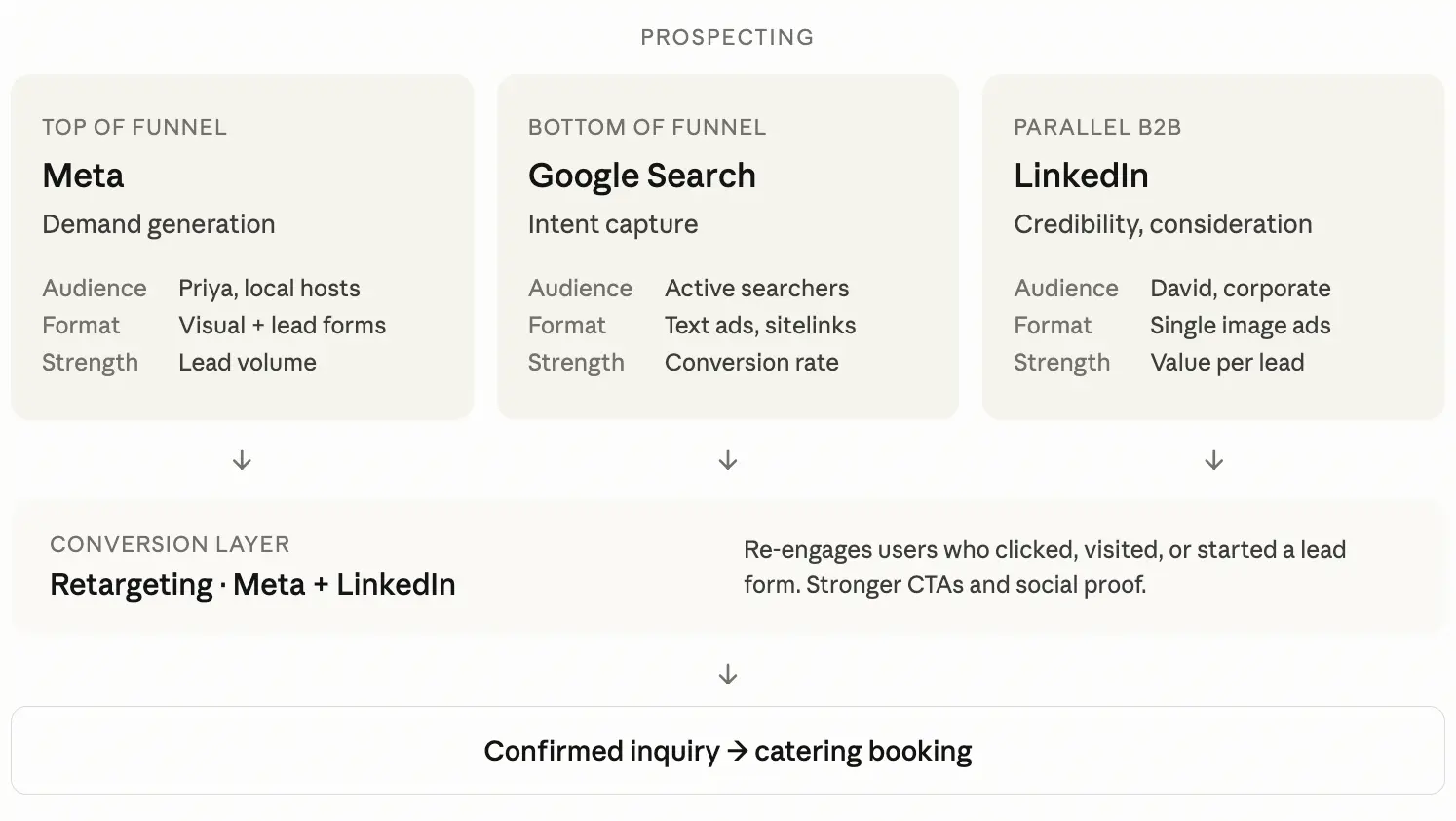
The campaign uses three paid channels — Meta, Google Search, and LinkedIn — supported by a retargeting layer. Each channel was selected to perform a specific role within the funnel, and each is paired with the audience moment it is best suited to capture.
The three channels do not work in sequence. A potential customer does not move from Meta to Google Search to LinkedIn in a linear path. Instead, the channels run in parallel, each one catching a different type of buyer at a different decision moment. Removing any one of them would leave a measurable gap in the funnel.
Meta — top of funnel, demand generation
Meta (Facebook and Instagram) reaches local audiences who are in the early stages of event planning but are not yet actively searching for a caterer. The channel is used to generate demand, build awareness of Alijandro’s Kitchen as a catering option, and capture leads through in-platform lead forms.
The creative on Meta carries the visual weight of the campaign through birthday setups, wedding tablescapes, and event scenarios that signal the kind of moment the brand is built for. This is the channel that introduces the brand to Priya before she has decided how she will handle the food.
Google Search — bottom of funnel, intent capture
Google Search is the highest-intent channel in the plan. Users searching for terms such as “corporate catering near me” or “birthday catering Mississauga” have already decided they need a caterer and are actively evaluating options.
The role of Search is not to create interest, but to capture it at the moment of decision. Because intent is high, conversion rates on Search are higher and the cost per lead is lower than on the other channels, which is why Search receives the largest budget allocation in the plan.
LinkedIn — parallel B2B track, credibility and consideration
LinkedIn operates as a separate track within the architecture, targeting a different buyer entirely. Where Meta and Google Search reach private hosts like Priya, LinkedIn reaches corporate decision-makers like David — HR managers, office managers, and event planners researching vendors for company events.
The channel produces lower lead volume than Meta or Search, but each lead carries higher revenue potential because corporate bookings are typically larger in size and tend to recur. The role of LinkedIn is to build credibility in front of professional buyers and to place Alijandro’s Kitchen on their consideration list before they need it.
Retargeting — the conversion layer
Retargeting runs across Meta and LinkedIn, and serves a different purpose from the prospecting channels. Its job is to re-engage users who have already interacted with the brand — those who clicked an ad, visited the website, or started a lead form without completing it.
Retargeting creative emphasizes booking actions, social proof, and reasons to act now, with the goal of converting warm interest into confirmed inquiries before that interest cools.
Campaign Budget and projections
The campaign operates on a total budget of $3,600 over 90 days, or $1,200 per month. The budget is divided across the three channels according to the role each one plays in the funnel and the cost-efficiency of generating leads on each platform.
How the budget is allocated
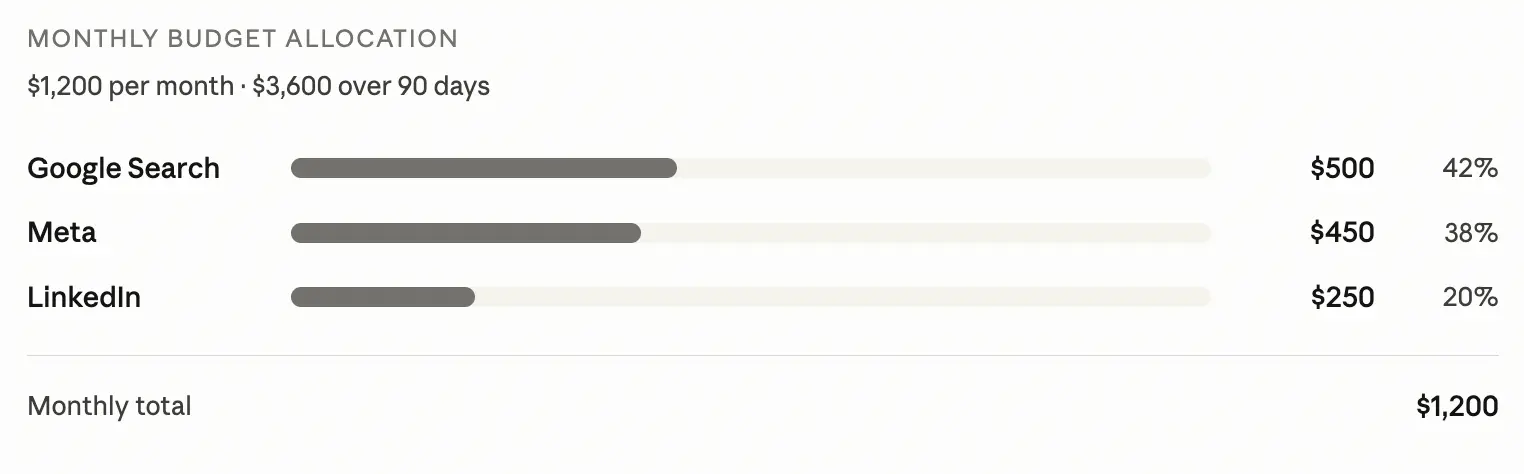
Google Search receives the largest share at $500 per month, or approximately 42%. This allocation reflects the channel’s position at the bottom of the funnel, where users are already searching with intent and conversion rates are highest.
Concentrating the largest investment behind the highest-converting channel maximises the number of qualified leads the campaign can produce within the available budget.
Meta receives $450 per month, or approximately 38%. While Meta does not capture intent at the same level as Search, it produces the highest lead volume in the plan because of its low cost per click and large addressable audience in the Mississauga area.
The Meta budget covers both prospecting (introducing the brand to new audiences) and retargeting (re-engaging users who have already shown interest).
LinkedIn receives $250 per month, or approximately 20%. The allocation is smaller because the platform produces the lowest lead volume of the three channels and carries a higher cost per click.
However, the channel earns its place in the budget because corporate bookings — the type of bookings LinkedIn leads convert into — are significantly larger and more recurring than private events. A single corporate client booking quarterly lunches can outweigh the revenue generated from several individual birthday catering jobs.
How each channel is bought
The three channels operate on different buying models, chosen to match the role each one plays. Google Search and LinkedIn both run on a cost-per-click (CPC) basis, because both channels are paying for intent and direct engagement.
A click on Google Search signals that the user is actively evaluating catering options. A click on LinkedIn signals that a professional buyer has stopped scrolling on a piece of business-relevant creative. In both cases, the click is the meaningful action being paid for.
Meta runs on a cost-per-thousand-impressions (CPM) model because the channel’s role is reach and demand generation. The objective on Meta is to put the brand in front of as many qualified local audiences as possible during the event-planning window, before those users move into active search behaviour.
Projected performance
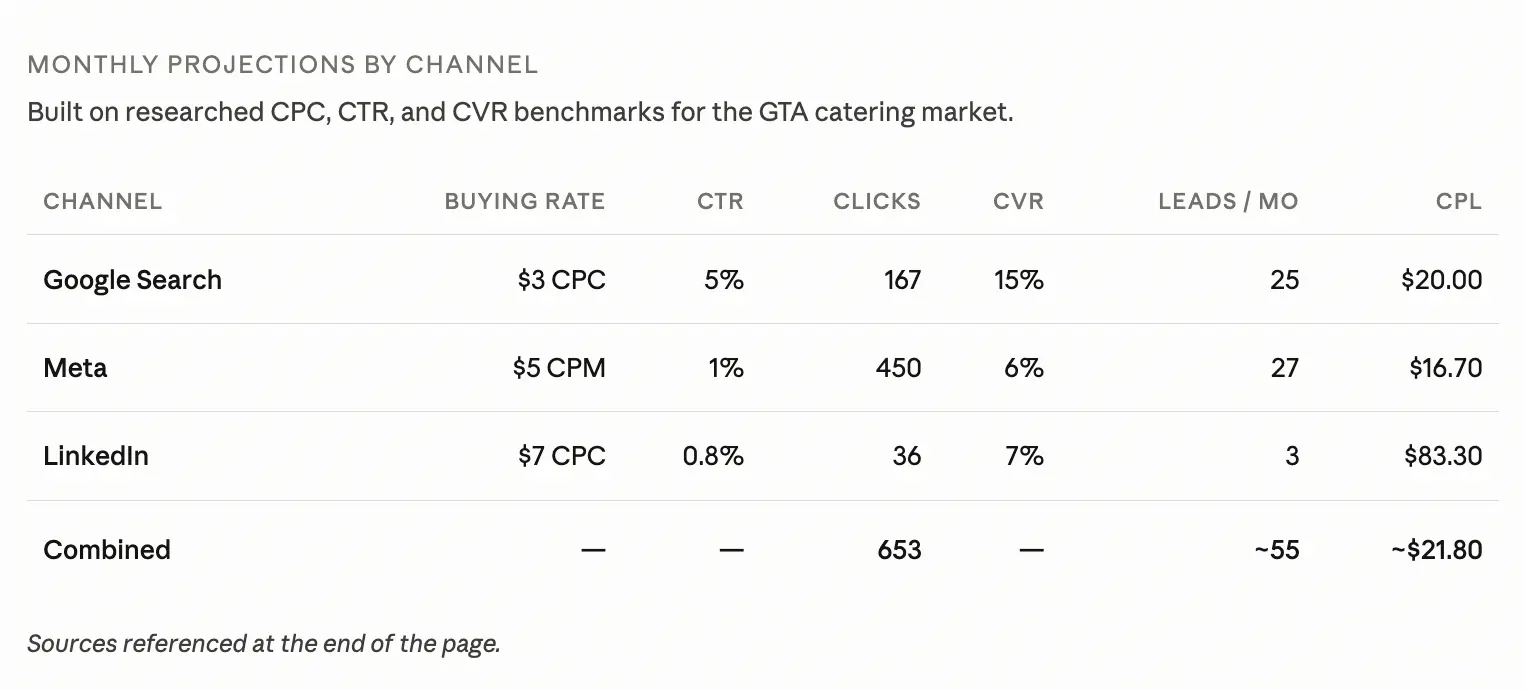
The table below maps each channel’s full performance projection — from impressions and clicks through to qualified leads and cost per lead. The figures are based on researched CPC, CTR, and CVR benchmarks for the GTA catering market, with sources referenced at the end of the page.
The combined monthly output across the three channels is approximately 55 qualified leads, or roughly 165 leads over 90 days. The remaining 15 leads required to reach the 180-inquiry target are projected to come from retargeting activity in months two and three, once enough audience data has accumulated on Meta to begin re-engaging warm interest at a lower cost per lead.
At a ~30% inquiry-to-booking conversion rate, the 180 inquiries are projected to produce the 50 confirmed bookings the campaign was designed to deliver.
The Conversion Path
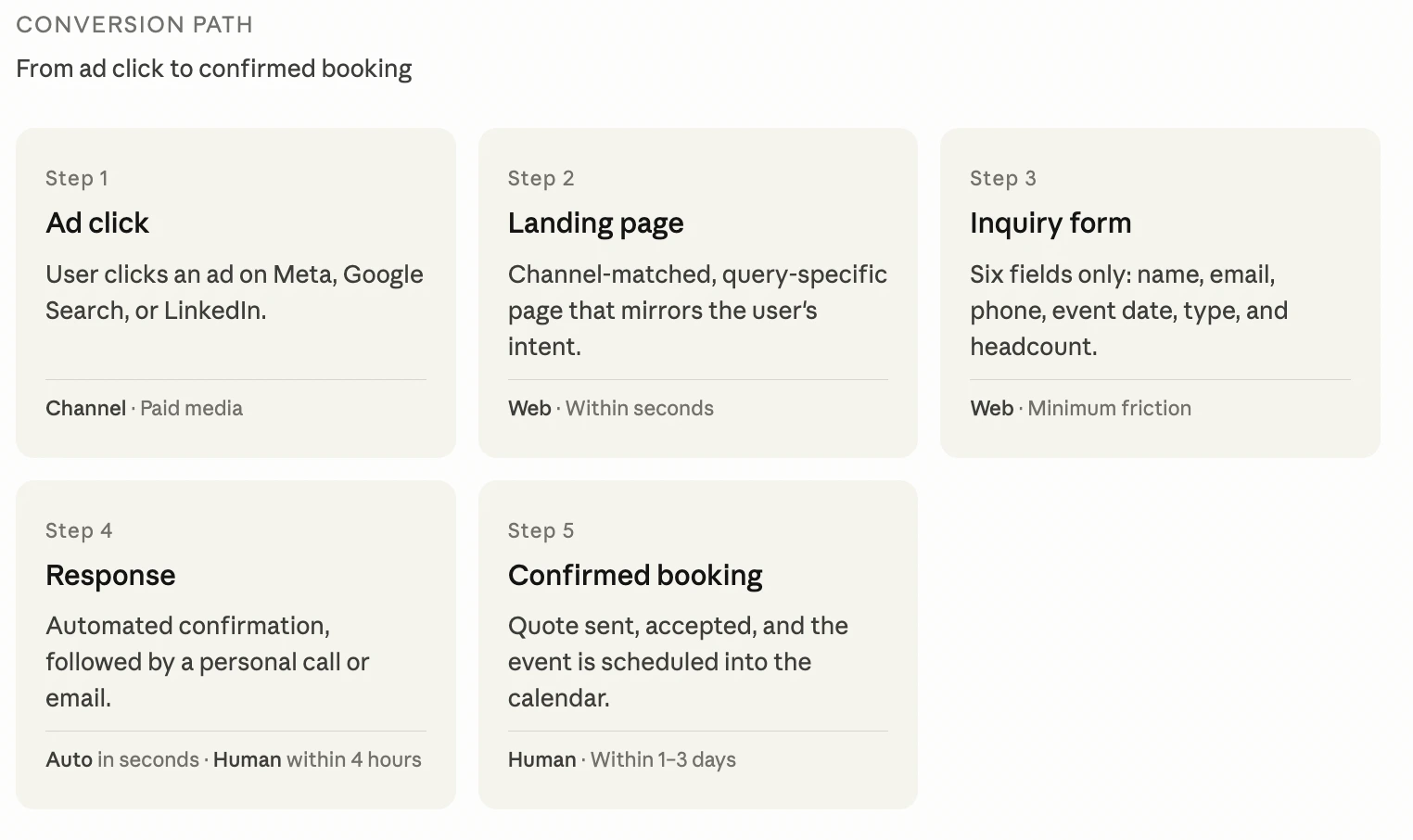
A paid media plan only works if the path after the click is built to convert. Strong creative and high-intent targeting will both fail if the inquiry experience adds friction or response delays. This section documents the post-click flow that turns ad clicks into confirmed catering bookings.
The conversion path is designed around two principles. First, minimise friction at the inquiry stage, because every additional form field or extra page reduces the completion rate. Second, respond to inquiries fast enough to capture the user before their attention shifts to another vendor.
Both principles matter more in catering than in most categories, because catering decisions are time-bound by the date of the event, and a host who sends three inquiries on the same evening will usually book whichever vendor responds first.
Where each channel lands
Different channels carry different intent, and the conversion path is differentiated accordingly.
Meta clicks are split between two destinations. Some creative drives users to an in-platform lead form, which pre-fills name, email, and phone number directly from the user’s Facebook or Instagram profile. This reduces friction to nearly zero and produces the lowest cost per lead in the plan.
Other Meta creative drives users to a dedicated landing page when the objective is to qualify the lead before contact, such as collecting event date, headcount, and event type up front.
Google Search clicks land on dedicated landing pages matched to the search query. A user searching for “birthday catering Mississauga” lands on a birthday-specific page with relevant imagery and copy.
A user searching for “corporate catering near me” lands on a corporate-specific page. Query-matched landing pages outperform generic homepages on conversion rate because they reduce the cognitive load between the search intent and the inquiry action.
LinkedIn clicks land on a single corporate landing page built specifically for the David persona. The page emphasises reliability, transparent pricing, and the kind of professional services language that a corporate buyer recognises.
The inquiry form on this page collects company name, headcount, and recurring event frequency, in addition to standard contact information.
The inquiry form
The inquiry form is the highest-leverage element in the entire conversion path. Every field added to the form reduces the completion rate, so the form is designed with only the minimum information required to begin a meaningful conversation.
The fields are: name, email, phone number, event date, event type, and approximate headcount. Budget, dietary requirements, and other event-specific details are collected during the follow-up conversation rather than on the form itself.
The principle is to keep the threshold for inquiry submission as low as possible and to push qualification work into a human conversation, where conversion rates are significantly higher than on a web form.
The follow-up
A submitted inquiry receives an automated confirmation email within seconds, which sets the expectation that a member of the catering team will respond personally within one business day. In practice, the response target is four hours during business hours, because catering inquiries cool quickly and the first vendor to respond is often the vendor who books the event.
The personal follow-up is a brief call or email that confirms the event details, asks the remaining qualification questions, and proposes a quote. Once the quote is accepted, the booking is confirmed and the inquiry has converted into revenue.
Ad Scheduling
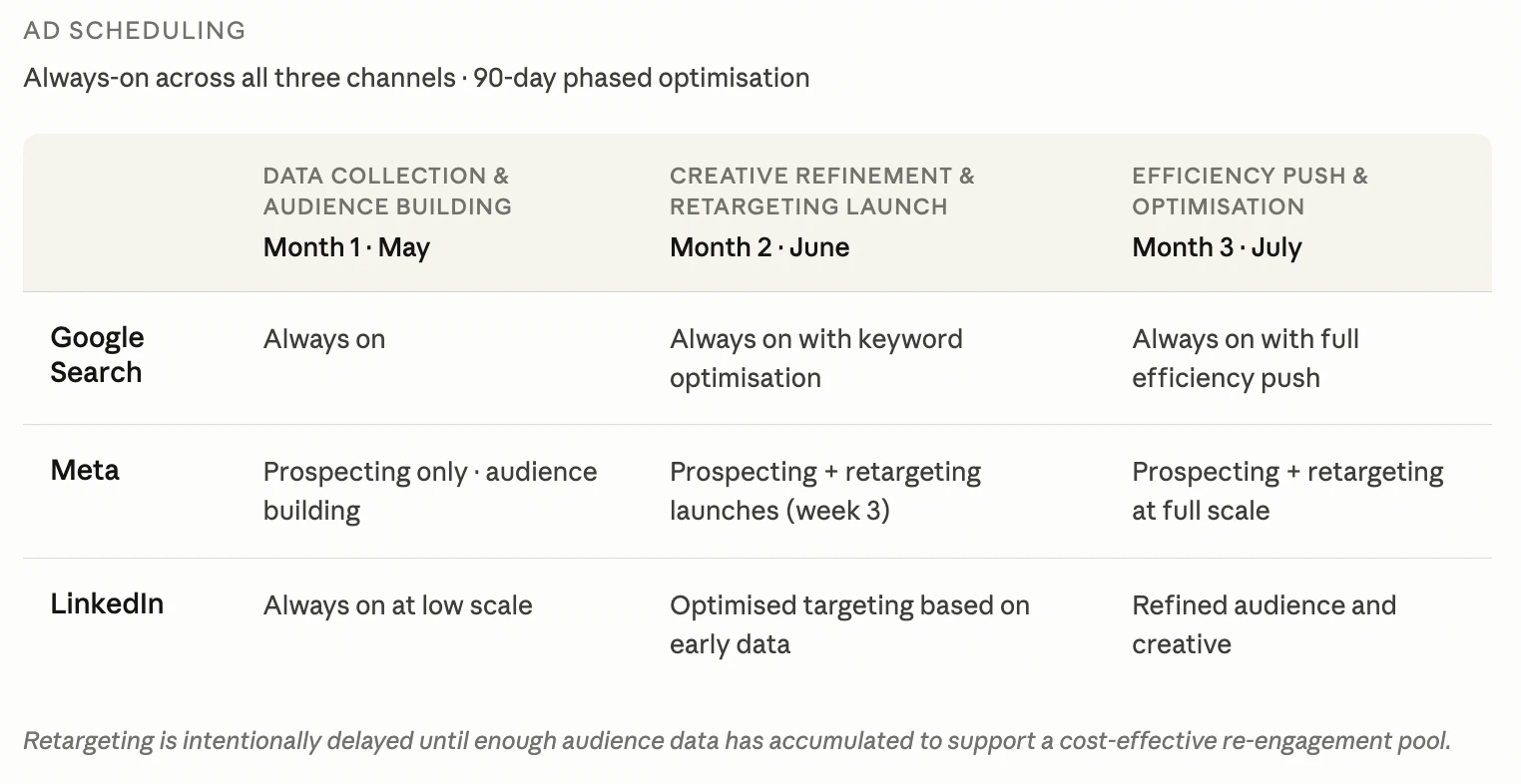
The Ads are on an always-on schedule for the full 90 days, with no major spend bursts or paused windows. Catering inquiries do not follow a marketing calendar — they follow real life. A corporate planner who needs catering for the following Friday and a parent who realises their daughter’s birthday is three weeks away both generate inquiries on the same day, regardless of which week of the campaign it is. A consistent presence ensures the campaign captures that constant baseline of demand, rather than missing inquiries during dark periods between bursts.
Within the always-on model, three scheduling decisions shape how the campaign evolves over the 90 days.
Retargeting launches in month two. Retargeting only works once there is an audience to retarget. Running it on day one would spend budget against an audience pool too small to be meaningful. The plan waits approximately two weeks into month one, by which point the Meta prospecting layer has accumulated enough website visits and ad engagement to support a cost-effective retargeting pool.
Each month has a distinct optimization focus. Month one is the data collection and audience building phase, where the priority is gathering enough performance data across channels to identify which creative, keywords, and audience segments are working. Month two is the creative refinement and retargeting launch phase, where underperforming creative is replaced with iterations of what is working, and the retargeting layer goes live. Month three is the efficiency push, where bid strategies are tightened, underperforming keywords are paused, and budget within each channel is reallocated toward the segments delivering the lowest cost per lead.
LinkedIn scales gradually rather than aggressively. Because LinkedIn produces low lead volume and a higher cost per click, the channel is not scaled heavily during the 90 days. The objective on LinkedIn is to validate that the channel can produce qualified corporate inquiries at an acceptable cost — not to chase volume. If month three data shows strong corporate lead quality, the channel becomes a candidate for increased investment beyond the campaign window.
Reflection - What I would refine
If I were to run this campaign with a real budget rather than as a strategic plan, three things would be at the top of my list to refine.
Validate the LinkedIn allocation before committing to it
The 20% LinkedIn allocation rests on a strategic argument — corporate bookings are larger and more recurring than private events, so a lower lead volume can still deliver strong return. The argument is defensible, but it has not yet been tested with live data.
If I were running this for real, the first thirty days would include an A/B test that splits the LinkedIn budget between LinkedIn itself and an equivalent investment in Meta retargeting aimed at corporate audiences.
If Meta retargeting delivers comparable or better corporate inquiries per dollar, the LinkedIn budget would be reallocated. If LinkedIn holds its ground, it earns its place in the plan with evidence rather than logic alone.
Add an email nurture layer for inquiries that do not book
The current plan converts inquiries into bookings inside a relatively narrow window — the few days between the inquiry submission and the quote acceptance. Inquiries that go cold after the initial follow-up are effectively lost.
A simple three-email nurture sequence, triggered automatically on inquiry submission, would re-engage those leads over the following weeks. The emails would feature event galleries, menu options, and a soft offer to re-open the conversation.
This is a low-cost addition that lifts the overall inquiry-to-booking conversion rate without increasing media spend, and it makes better use of leads that the paid campaign has already paid to acquire.
Build a referral loop into the post-booking experience
Every confirmed booking is a potential source of future bookings. The current plan ends at the moment the booking is confirmed, but the days immediately after a successful event are the highest-value window for generating reviews and referrals.
A post-event email asking for a Google review, combined with a referral incentive — a discount on a future booking, or a free dessert platter for a referred friend’s event — would compound organic growth on top of the paid campaign.
Over time, a working referral loop reduces the campaign’s reliance on paid acquisition and improves blended cost per booking.
This campaign was built as a strategic plan rather than a live deployment. The numbers, the channel logic, and the conversion path are designed to be defensible in a real-world brief — and to evolve once real data starts coming in.